Fitness, Nutrition, Health and Sports Blog In the HSNstore Blog you will find tips about Fitness, sport in general, nutrition, and health – HSNstore.com

The crunch is one of the most effective exercises for strengthening the abdomen, but also one of the most poorly executed. If you feel your neck working more than your core, you’re wasting time and putting yourself at risk of injury!
Below, I’ll explain in 30 seconds how to do it correctly, activating only the muscles that matter and protecting your back.
1. Lie on your back:
- Knees bent, feet flat on the floor (hip-width apart).
- Hands lightly behind your ears (without pulling your neck) or crossed over your chest.
- Gaze toward the ceiling, chin away from your chest.
2. Activate your core:
- Draw your navel toward your spine before moving (keep this tension!).
3. Lift (Exhaling)
- Lift only your shoulders and upper back off the floor.
- Flex your spine one vertebra at a time (short, controlled movement).
- Your neck only follows the movement! (The force comes from your abs).
4. Lower (Inhaling)
- Lower your back slowly, controlling the descent.
- Do not relax your abs when touching the floor! Keep your core engaged for the next rep.
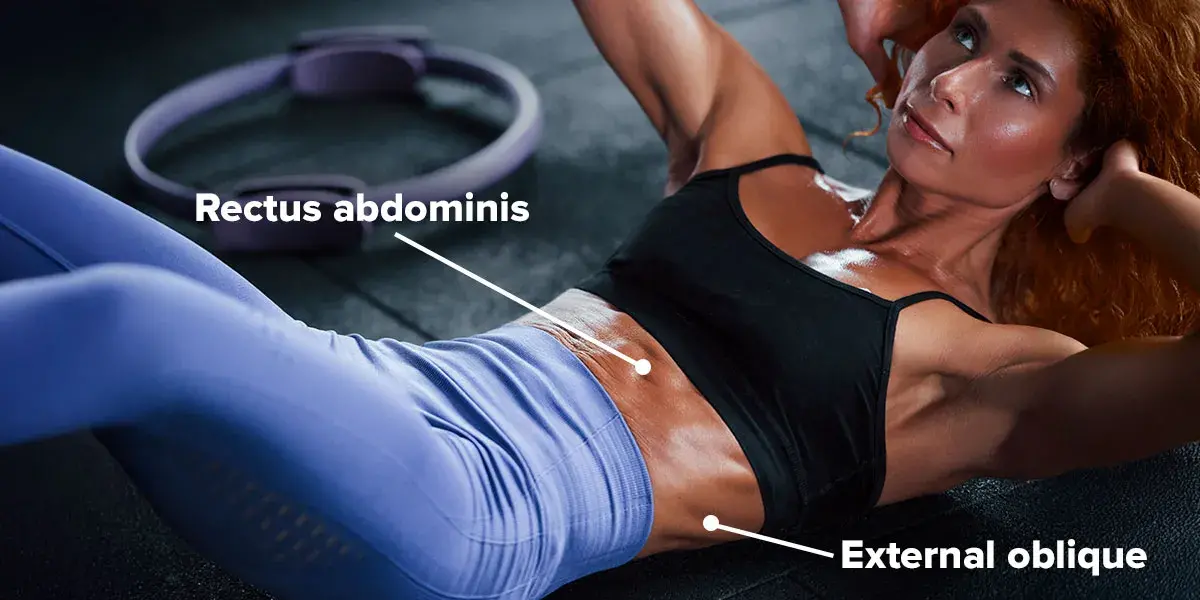
Muscles involved
How to include the abdominal crunch in your training routine
| Timing | Frequency (times/week) | Sets & Reps | Ideal combination | Key tips |
| Warm-up | 1–2 | 1–2 of 10–15 | Lumbar mobility + diaphragmatic breathing | Only if using a light crunch for activation. Don’t fatigue the core before strength work. |
| Post-Strength | 2–3 | 3 of 12–20 | Planks + Russian twists + leg raises | Ideal timing! Core is already activated. Prioritize technique over weight. |
| Core Day | 1–2 | 4 of 15–25 | Bird-dog + glute bridge + dead bug | Combine with anti-rotation and lower back exercises. Don’t rely only on crunches. |
| HIIT Circuit | 1 | 2–3 (max. 30 sec) | Jumps + burpees + mountain climbers | Use it as an active recovery station. Maintain form under fatigue! |
| Recovery | Optional (1) | 2 of 10 (slow) | Stretching + deep breathing |
Crunch variations
Include these progressions adapted to all levels:
1. Reverse crunch
- Lie on your back, legs elevated (knees at 90°).
- Hands on the floor at your sides.
- Bring your knees toward your chest (lifting hips off the floor), contracting the lower abs.
- Lower slowly without letting your feet touch the floor.
2. Crunch with elevated legs
- Lie on your back, legs extended toward the ceiling (forming 90° with your torso).
- Hands behind your ears (no pulling).
- Lift shoulders and shoulder blades (like a classic crunch), pressing your lower back into the floor.
- Hold for 1 second at the top.
3. Rotational crunch (Bicycle)
- Lie on your back, hands behind your ears.
- Bring your right elbow toward your left knee while extending your right leg (about 45° from the floor).
- Alternate sides in a smooth motion.
- Rotate from the ribs, not the neck.
4. Weighted crunch
- Lie on your back, knees bent, feet flat on the floor.
- Hold a plate, dumbbell, kettlebell, or medicine ball over your chest (not toward your neck).
- Lift shoulders and shoulder blades by contracting your abs, without lifting your lower back.
- Lower in a controlled manner without fully resting your shoulders.
- Keep the weight stable to avoid involving the arms.
Potential benefits of crunches for back issues
- Increased fluid flow and nutrition to the discs. Lumbar flexion enhances nutrient delivery to the discs by increasing fluid exchange.
- Increased tissue remodeling. With proper programming, spinal flexion exercises strengthen disc tissues, improving tolerance to lumbar flexion and helping prevent future injuries.
- Sagittal plane mobility. Some studies have linked lack of spinal mobility with lower back pain, although evidence is mixed. At the very least, crunches may help prevent loss of spinal mobility, which is important for preventing lower back pain.
- Rectus abdominis hypertrophy. Dynamic exercise is superior to isometric exercise for increasing muscle mass, partly due to greater muscle damage from eccentric activity and increased metabolic stress. Therefore, to optimize the appearance of a “six-pack,” crunches or spinal flexion movements can help achieve this goal when properly combined.
- Performance improvement. Contrary to some claims, lumbar flexion is common in many sports (e.g., swimming turns, martial arts…). Therefore, concentric–eccentric cycles help strengthen movement patterns.
Related Posts