 Fitness, Nutrition, Health and Sports Blog In the HSNstore Blog you will find tips about Fitness, sport in general, nutrition, and health – HSNstore.com

In general, when looking at the results of individual endurance events, there seems to be a trend that as the athlete’s age increases, so does the length of the race they participate in. In this specific case, we’re going to focus specifically on the peak performance age in ultra-endurance events.

The champion in most races is defined by covering a set distance the fastest. The protocol we’re looking at to find out which age is most related to better performance, however, is a less common type of race where athletes run for a set time and compete to cover the maximum possible distance. The races studied took place between 1975 and 2012 and were for the following time periods (even the shortest race on this list is longer than a marathon):
- 6 hours
- 12 hours
- 48 hours (2 days)
- 72 hours (3 days)
- 6 days
- 10 days
The data was examined in relation to age in many different ways, including the average age of the top ten finishers in each category, the average age of all-time high-level finalists, the age differences among those who finished the race for each time period…
Peak performance ages don’t increase with race distance
In most cases studied, there was a bell curve for the ages of the best-performing athletes; for example:
- The age of the top ten women finalists of all time in each category ranged from 41 years old for the six-hour race, up to 46 years for the 48-hour race. Then, it dropped back down to 37 years for the ten-day races.
- For men, the average age of the top ten finalists in each category peaked in the 72-hour race: 51 years old.
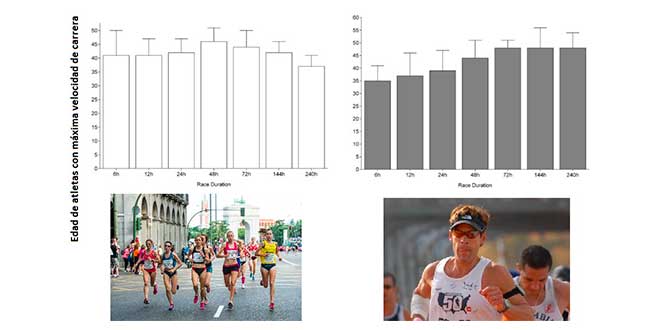
The only trends that didn’t resemble a bell curve were the top ten male finalists of all time, without grouping by categories. In this case, 35 years seems to be the best age to place among the leaders in 6-hour races; while for races between 3 and 10 days, it’s 48 years, with no significant variation depending on distance.
Researchers also found differences over the years in terms of preparation for this type of event. In 1982, the ten fastest male finalists in 48-hour races had an average age of 40 years; while in 2012, this age had increased by 10 years (50 years average age).
Conclusions and tips
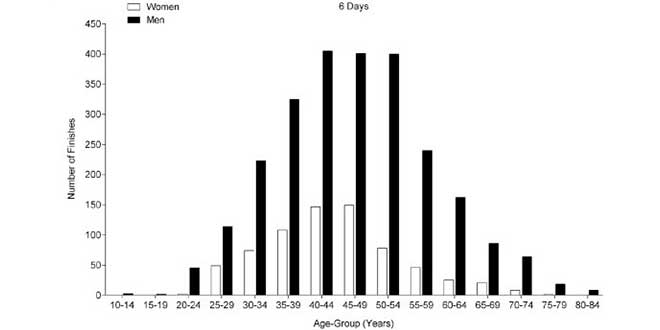
There may be a statistical reason why the average age of peak success in ultra-endurance races doesn’t increase as race length does; one likely reason being the reduced participation as the event lasts longer, especially among women. In this sense, with fewer runners for longer events (3-10 days), the statistical strength of the results is also lower.
What is clear and backed by research and real race results is that the most successful ultra-marathoners (both men and women) tend to be over 35 years old, and many are well into their 40s (more like close to 50 for very long-lasting races).
The data presented can be interpreted superficially by age, thinking that reaching a mature age will make it easier to finish and even place well in this type of race; but you have to be aware of your own capabilities and experience.
To participate in the first ultra-marathon, the average prior training is 7 years; and those who show the best performance also have 7 years of previous ultra-marathon experience (so, in total, about 14 years of training in very long distances); training up to 3500 kilometers a year (roughly the distance from Madrid to Moscow) for the longest ultra-marathons of the year.
Sources
- Rüst, C. A., Zingg, M. A., Rosemann, T., & Knechtle, B. (2014). Will the age of peak ultra-marathon performance increase with increasing race duration?. BMC sports science, medicine and rehabilitation, 6(1), 36.