Fitness, Nutrition, Health and Sports Blog In the HSNstore Blog you will find tips about Fitness, sport in general, nutrition, and health – HSNstore.com

In this article, we’re going to explain and give an example of how to interpret the labels on plant extract supplements.
No doubt about it, the use of medicinal plants and their extracts is all the rage. The list of varieties is practically endless, and the range of benefits they promise is no joke.
What Are Plant Extracts?
We know that our diet doesn’t just provide carbs, fats, proteins, vitamins, and minerals, but also other components like polyphenols (you’ve probably heard about polyphenols in extra virgin olive oil, for example), which can play important roles in consumer health.
The set of “functional molecules” present in foods is known as bioactive compounds
Phytonutrients are organic compounds found in the plant kingdom that can offer interesting health benefits
Classification of Bioactive Compounds
Plant bioactive compounds can be classified into 3 main categories based on their structures:
- Terpenes and terpenoids: over 25,000 types
- Alkaloids: around 12,000 types
- Phenolic compounds: around 8,000 types
What Steps Are Taken Before Marketing a Plant Extract?
- Selection of plant species: This phase analyzes which plants have been traditionally used for a specific purpose. Once identified, literature is reviewed, and the validity of the studies is checked. Based on this, the decision to continue with analyses or not is made.
- Toxicity evaluation: The idea is to gather available toxicity info, and if everything points to non-toxicity, an appropriate analysis is done to directly assess safety and toxicity.
- Preparation of a plant sample and analysis: A plant sample is obtained and extracted. Various protocols are used to compare selectivity and yield—that is, how well the compound of interest is isolated and how much raw material is needed to get a certain amount.
- Biological tests: Once the right procedures and protocols are selected, the biological activity is analyzed in vitro. This evaluates the type and level of activity.
- Isolation of active compounds: This step involves characterizing and isolating the specific compounds responsible for biological activity. They’re also tested alone or combined to see if there are synergies.
- In vivo analysis: Compounds are re-evaluated, this time in animal models. Toxicity, safety, and activity are reassessed. If results are favorable, human trials are conducted.
- Marketing: The final phase. Optimal doses and intake formats are established. Viability is studied, evaluating cost-effectiveness and sustainability at industrial production level.
Extraction Techniques
What’s It About?
The two main reasons for doing an extraction are:
- To concentrate the molecule or compound of interest for use in a smaller, more practical format.
- To remove potentially unwanted ingredients.
There are several techniques to extract compounds of interest from plants
The phytochemical or bioactive compound content of an extract largely depends on the extraction techniques and solvents used, as well as the plant’s origin and storage conditions (Leyva-Jiménez et al., 2018)
Examples of Solvents and Bioactive Compounds Extracted
| Solvent | Bioactive Compounds |
| Water | Anthocyanins, Tannins, Saponins, Terpenoids |
| Ethanol | Tannins, Polyphenols, Flavonol, Terpenoids, Alkaloids |
| Methanol | Anthocyanins, Terpenoids, Saponins, Tannins, Flavones, Polyphenols |
| Chloroform | Terpenoids, Flavonoids |
| Dichloromethane | Terpenoids |
| Ether | Alkaloids, Terpenoids |
| Acetone | Flavonoids |
The biggest issues with traditional methods are longer extraction times, the need for expensive solvents, lower selectivity for compounds of interest, and more breakdown of heat-sensitive substances.
New Extraction Techniques and Their Advantages Over Traditional Methods
- Ultrasound-assisted extraction: cuts down time, solvent volume, and energy used.
- High-voltage pulsed electric field extraction: maximizes extraction of compounds by breaking down cell membranes.
- Enzyme-assisted extraction: frees substances that might be bound to other molecules inside plant cells.
- Microwave-assisted extraction: reduces use of organic solvents and is quite selective for certain compounds. For example, it’s one of the best for extracting caffeine and polyphenols from tea leaves.
- Pressurized liquid extraction (PLE): main perks are less solvent and time needed, largely thanks to high automation. Plus, high pressure helps the extraction process.
- Supercritical fluid extraction (SFE): uses temperature and pressure to bring solvents to a supercritical state. Usually CO2 is used, which is liquid under supercritical conditions and helps transfer bioactive compounds from plant to solvent. When the process ends and conditions return to normal, CO2 evaporates leaving the extract solvent-free. It’s also used for coffee decaffeination.
What Is the Extraction Ratio?
Whether you’re a regular extract user or not, you might have seen numbers like 10:1, 20:1, or 35:1 on labels.
These numbers refer to the “extraction ratio”
You might also see another number, this time as a percentage, which tells us about the “standardization” regarding a specific component of the extract
Example: “10:1 Extract of Astragalus Membranaceus Plant”
To explain this, we’ll use an example of a 10:1 extract from Examine.com about the plant Astragalus membranaceus and the extraction of the bioactive compound astragaloside IV:
- Let’s say 20 g of raw powder from the root contains the amount of astragaloside needed for beneficial effects.
- If extracted with ethanol, soluble and insoluble residues separate. In this example, the soluble fraction is 2 g and the insoluble 18 g.
- If all astragaloside IV is in the ethanol-soluble fraction, it means we concentrated the plant’s part of interest and ended up with an 18 g residue.
So, we get an extract with a 10:1 extraction ratio, since we started with 20 g and got 2 g of extract. The math is simple: 20/2=10; meaning 1 part extract per 10 parts raw material.
In other words, we “packed” into 1 gram what used to be in 10; we concentrated it 10 times
What Is Standardization?
The other concept to explain is standardization. It refers to the concentration of the compound of interest, so it’s like a “quality control.”
With standardization, we make sure that, regardless of the procedure or extraction ratio, we have a set concentration of the active ingredient.
Different techniques might have been used to get them, requiring more or less raw material, solvents, or time, but the end result is similar in terms of the concentration of the substance we want
What Am I Buying When I Get a Plant Extract?
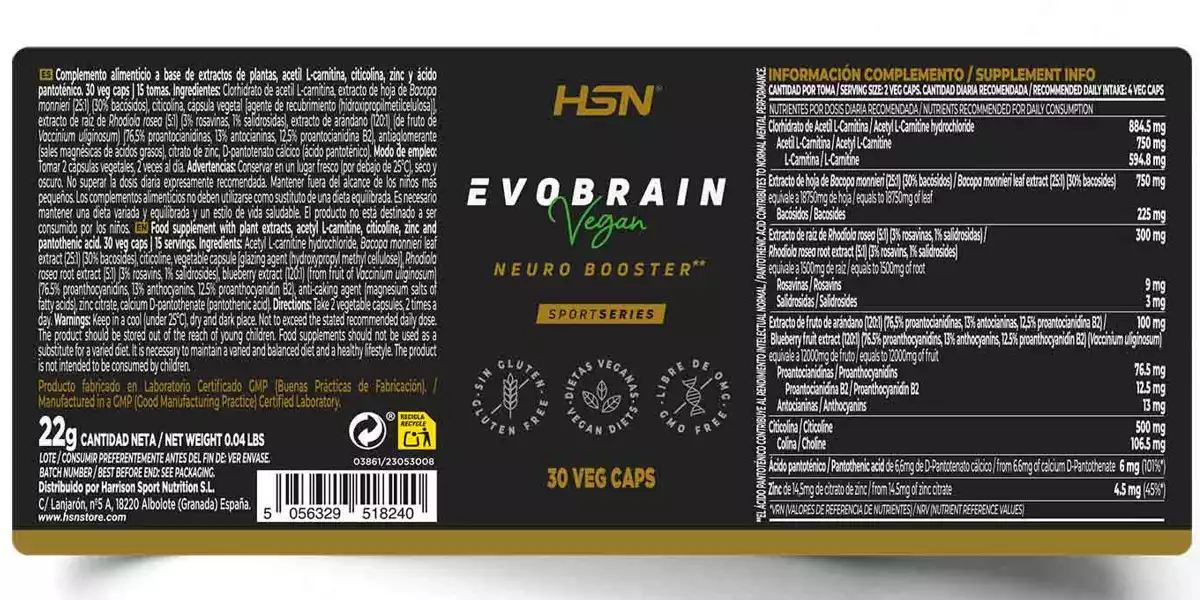
To explain, let’s analyze the label of one of our products: EvoBrain
What’s the explanation?
This is where extraction ratios come in. Check the fine print next to the plant names Bacopa monnieri and Rhodiola rosea.
They’re 25:1 extracts, meaning each part in the capsule equals 25 parts of the original material. So here’s what we find:
- For Rhodiola Rosea: the actual amount is 300 mg of 5:1 extract. Multiplying 300 mg x 5 gives 1500 mg, which is the amount of Rhodiola Rosea root listed in the table.
- The same goes for Bacopa: 750 mg of extract x 25 equals 18,750 mg, the amount of Bacopa monnieri leaves used.
- These extracts are standardized to 3% rosavins (Rhodiola rosea) and 30% bacosides (Bacopa monnieri).
Summary
- Plants, besides the usual nutrients (carbs, fats, proteins, vitamins, minerals), provide certain substances that can have health benefits. These are known as nutraceuticals, phytochemicals, or bioactive compounds.
- Plant extract products aim to isolate and concentrate these substances or remove others that might be potentially harmful.
- Before an extract hits the market, it must go through research phases and safety tests for consumers, including in vitro and animal model studies.
- There are many techniques to obtain these extracts, divided into traditional and non-traditional. Usually, the latter improve extraction ratios and optimize resource and time use.
Sources
- Leyva-Jiménez et al., (2018). Comparative study of conventional and pressurized liquid extraction for recovering bioactive compounds from Lippia citriodora leaves.
- Azmir et al., (2013). Techniques for extraction of bioactive compounds from plant materials: A review.
- Bielsalski et al., (2009). Bioactive compounds: Definition and assessment of activity.
Related Posts
- Food Labeling in Europe
- How to Interpret Food Labels?
- Everything you need to know about Astragalus Extract: read now.