Fitness, Nutrition, Health and Sports Blog In the HSNstore Blog you will find tips about Fitness, sport in general, nutrition, and health – HSNstore.com

Potassium is one of those minerals you have heard about all your life, but did you know that it is an essential substance for heart health and optimal vascular function?
Vital for the body to achieve its overall balance, your health may be affected if abnormally high or low potassium levels are detected. We explain everything you need to know about a mineral so important that it regulates the heartbeat.
What is Potassium?
It is an essential mineral found in the body that is particularly important for cellular and electrical function. It is one of the main electrolytes, along with sodium and chloride, which means that it carries a small electrical charge (potential).
In many of its functions, it acts in opposition to sodium, and both positive ions are jointly balanced by the negative chloride ion.
What is potassium used for?
What better way to explain it than visually? Here is our HSN infographic!
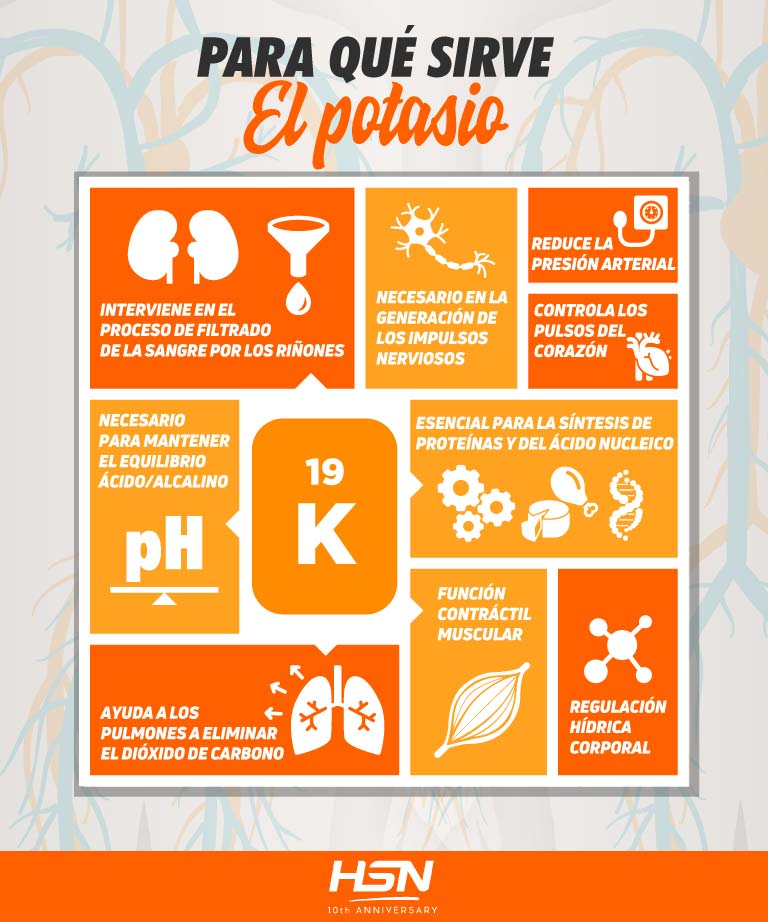
HSN infographic
Properties of Potassium
This substance plays a role in vital functions involving muscle and cardiac contraction, nerve impulse transmission, hydration and acid-base balance, which depends, among other things, on potassium, sodium, chloride and bicarbonate levels.
Its functions are therefore essential for the optimal functioning of the body, so let us review the main ones:
Regulating fluid balance
Together with sodium, it regulates water balance and the acid-base balance in the blood and tissues. It has the particular ability to enter cells more easily than sodium, triggering the brief sodium-potassium exchange across cell membranes.
Supporting the conduction of nerve impulses
Controlling the heartbeat
As an electrical potential gradient generated by the “sodium-potassium pump”, it helps to generate muscle contractions, regulating the heartbeat.

Taking part in energy metabolism
As an important component in cellular biochemical reactions and energy metabolism, potassium is involved in carbohydrate metabolism, helping convert glucose into glycogen and store it as a future source of energy.
Protein synthesis
This electrolyte participates in the synthesis of protein from amino acids in the cell, playing an important role in normal growth and muscle development.
Controlling hypertension
Potassium has been shown to be beneficial in cases of hypertension, as an additional intake of this mineral increases sodium loss and therefore improves hypertension.
Potassium to prevent diabetes
A diet low in potassium contributes to lower insulin secretion. This is why a good way to prevent diabetes is to consume potassium-rich foods such as fruit, vegetables, pulses and nuts.
What does excess potassium cause in the human body?
The condition commonly known as “high potassium” is called hyperpotassaemia or hyperkalaemia , and its main cause in the body is an increase in intake, redistribution or reduced renal excretion. High potassium levels constitute a medical emergency due to the risk of cardiac arrhythmias.
A high level in the body can lead to:
- Hypertension
- Muscle weakness
- Cardiac arrhythmia
- Kidney disorders
- Muscle cramps and/or muscle paralysis

What about a deficiency?
The first thing you should know is that potassium deficiency is not particularly common. If you follow a diet rich in plant-based foods and do not have an underlying health condition, it should not generally be a major concern.
However, problems may arise when your diet is not as varied as it should be or if you have kidney disease or a metabolic disorder.
Experts also point to overly strict and poorly supervised diets as a cause of eating disorders, such as anorexia and bulimia, which can also contribute to potassium deficiency. The main problem with potassium deficiency is that it causes a decrease in plasma levels.
The most common symptoms of potassium deficiency are:
- Constipation
- Muscle weakness
- Tachycardia
- Fatigue
- Hypotension
- Tingling sensation
- Nerve dysfunction
- Water retention
- Persistent thirst
- Vomiting
- Cardiac arrhythmias (such as rhythm disturbances and palpitations)
Exercise causes Potassium loss
Athletes are among those with the highest potassium requirements, as exercise often causes potassium loss through sweat, while potassium is also needed for muscle and liver glycogen synthesis. In any case, whether or not additional doses of potassium are required will depend on the type and intensity of the exercise.
Taking certain medicines does too
Some diuretics promote calcium excretion through urine, a circumstance that should not be overlooked. This is one of the reasons why diuretics should not be taken indiscriminately. The same applies to consuming large amounts of diuretic herbal teas.

Find the recommended daily intake here
Under Regulation (EU) No 1169/2011 of 25 October 2011, the reference daily intake of potassium for adults is 2,000mg.
However, according to the recommendations issued by the Food and Nutrition Center of the Institute of Medicine, the amounts would differ by age range as follows:
- Children: ranges from 3 grams during early childhood to 4-4.5 grams between the ages of 4 and 13
- Adults and children aged 14 and over: 4.7 grams
Therefore, if you experience potassium loss, you should consult your doctor about the appropriate intake for your individual circumstances. Do you have a potassium deficiency? Find supplements such as potassium citrate in the HSN online store.
How can you regulate potassium levels?
If you are wondering how to regulate potassium levels to benefit from this mineral, we have good news for you. The body has its own control mechanisms to ensure adequate potassium levels that support the normal functioning of the nervous and muscular systems.
When the concentration rises, the adrenal glands secrete the hormone aldosterone, prompting the kidneys to excrete excess potassium. Conversely, when levels are low, secretion of this hormone decreases, leading to the conservation of the electrolyte discussed here.
Circumstances that interfere with potassium balance can affect the electrical impulses required to maintain the heartbeat, causing an abnormal rhythm in this vital organ.

Its balance with sodium is essential
The solution? Include a suitable balance of foods with a high potassium content, avoiding a mineral imbalance in the body.
Some tips to bear in mind…
- If you drink large amounts of coffee, you may be “masking” the fatigue you are experiencing.
- If you have an excessive craving for sweets, it may indicate low potassium levels.
- You lose potassium and magnesium through sweating. Replace them by eating fruit and vegetables a few hours after training.
- If you have hypoglycaemia, you may experience fluid retention and lose potassium.
- People with diabetes and kidney disease should seek medical advice regarding their intake.
Now that you are more familiar with potassium, do not forget to include it in your diet!
Bibliographical Sources:
- Tsuchiya T, Kijima A, Ishii Y, Takasu S, Yokoo Y, Nishikawa A, Yanai T, Umemura T. Mechanisms of oxidative stress-induced in vivo mutagenicity by potassium bromate and nitrofurantoin. J Toxicol Pathol. 2018 Jul;31(3):179-188. doi: 10.1293/tox.2018-0024. Epub 2018 Jun 2.
- NutritionData
Keep reading about this topic:
- The foods with the highest potassium content that you can find on the market. Keep reading.
- Are you an athlete? Do you know what the Sodium-Potassium Pump is? Find out about it in full.